Magento Architecture Consulting
Our Magento Architecture Consulting services help businesses build scalable, secure, and high-performing eCommerce platforms tailored to their unique needs. We analyze your existing Magento architecture, identify performance and scalability challenges, and develop a robust technical strategy for long-term growth. From system integrations and customizations to optimization and best practices, our experts ensure your Magento store is flexible, reliable, and ready to support evolving business requirements.
Build a Scalable and Maintainable Magento Architecture
A well-designed Magento architecture provides the foundation for a stable, scalable, and maintainable ecommerce platform. Our Magento Architecture Consulting services help businesses assess their existing Magento Open Source or Adobe Commerce implementation and define an architecture that supports business requirements, integrations, performance, scalability, and future development.
We evaluate the complete technical environment rather than focusing only on individual development issues. Our architecture review covers application modules, customizations, dependencies, APIs, databases, caching, indexing, integrations, frontend architecture, and infrastructure. This helps establish clear technical boundaries and reduce unnecessary complexity across your Magento platform.
Whether you are building a new Magento store, restructuring an existing implementation, preparing for an upgrade, or considering a headless storefront, we help define a practical architecture based on your actual technical and business requirements.
Magento Architecture Assessment
Our Magento Architecture Assessment examines how your existing platform is structured and how its different components interact. We review custom development, third-party extensions, module dependencies, integrations, data flows, and infrastructure to identify architectural issues that may affect maintainability, performance, scalability, or future upgrades.
We evaluate the application architecture as a whole and identify areas where custom functionality can be better organized, separated, or simplified. This provides a clear understanding of your current technical environment and helps establish a practical direction for architectural improvements.
Our assessment can cover:
- Custom modules and third-party extensions
- Module dependencies and customizations
- Database and data-access patterns
- APIs and external integrations
- Caching and indexing
- Cron jobs and message queues
- Frontend and backend architecture
- Deployment and infrastructure
Magento Solution Architecture
We design Magento solution architecture around your business processes, technical requirements, and expected growth. The architecture defines how important commerce capabilities such as catalog, customers, pricing, inventory, orders, checkout, payments, and external systems should interact.
Our approach focuses on clear module responsibilities, appropriate interfaces, controlled dependencies, and maintainable implementation patterns. Magento supports modular architecture, dependency injection, service contracts, and layered application design to help separate responsibilities between different components.
We also consider your existing technology stack, integrations, development workflow, and operational requirements. This helps ensure that the proposed architecture is practical to implement and maintain without introducing unnecessary technical complexity.
Magento Custom Module Architecture
Custom modules allow Magento functionality to be extended for specific business requirements. However, poorly structured modules can introduce unnecessary dependencies and make future development and upgrades more difficult.
We help design modules around specific business features with clearly defined responsibilities and dependencies. Where appropriate, we use Magento’s service contracts, dependency injection, plugins, observers, and other supported extension mechanisms instead of modifying core functionality.
Service contracts are PHP interfaces that define a module’s public API and provide a stable way for other modules and consumers to interact with its business functionality.
Our module architecture work includes:
- Custom module structure
- Module dependency analysis
- Service contract planning
- Dependency injection design
- Extension strategy
- Core customization review
- Module interaction analysis
Magento API & Integration Architecture
Magento implementations commonly integrate with ERP, CRM, PIM, OMS, payment, shipping, marketplace, analytics, and other external systems. We design integration architecture that defines how Magento communicates with these platforms and how data is exchanged between systems.
We consider API requirements, data ownership, synchronization methods, authentication, error handling, dependencies, and integration performance. Magento provides REST and GraphQL APIs, while the appropriate approach depends on the specific integration, storefront, or business requirement.
- ERP and CRM integrations
- PIM and catalog synchronization
- OMS and order processing
- Payment and shipping integrations
- Marketplace connections
- REST API integrations
- GraphQL integrations
- Data synchronization workflows
Magento Headless Architecture
For businesses that require a separate frontend application, we can design a headless Magento architecture where the storefront communicates with Magento through APIs. This approach separates the presentation layer from the commerce backend and can support custom frontend experiences.
We consider product and catalog data, customer accounts, carts, checkout, orders, authentication, API communication, caching, direct core modifications because changes to Magento core files can create maintenance and upgrade challenges. Where possible, custom functionality should and deployment requirements. The architecture is designed around your specific requirements rather than assuming that headless is necessary for every Magento implementation.
Magento Performance & Scalability Architecture
Magento performance depends on how application, data, integration, and infrastructure components work together. Database operations, indexing, caching, custom modules, API requests, search, queues, external services, and infrastructure can all affect platform performance.
We review these areas as part of the overall architecture and identify opportunities to improve how workloads are processed. Where appropriate, we consider caching, database optimization, asynchronous processing, API efficiency, and infrastructure scaling based on your actual traffic and workload requirements.
Key areas include:
- Database architecture
- Caching strategy
- Indexing
- API performance
- Message queues and asynchronous processing
- Search architecture
- External service dependencies
- Infrastructure scalability
Magento Architecture Modernization
As a Magento store evolves, custom modules, third-party extensions, integrations, and legacy implementations can increase architectural complexity. We assess the existing platform to determine which components should be retained, refactored, replaced, or reorganized.
Our modernization approach focuses on improving the existing architecture without automatically requiring a complete rebuild. This may include restructuring custom modules, reducing unnecessary dependencies, improving integration boundaries, replacing problematic customizations, and preparing the platform for future development.
We also review direct core modifications because changes to Magento core files can create maintenance and upgrade challenges. Where possible, custom functionality should use Magento’s supported extension mechanisms.
Magento Architecture for Upgrades
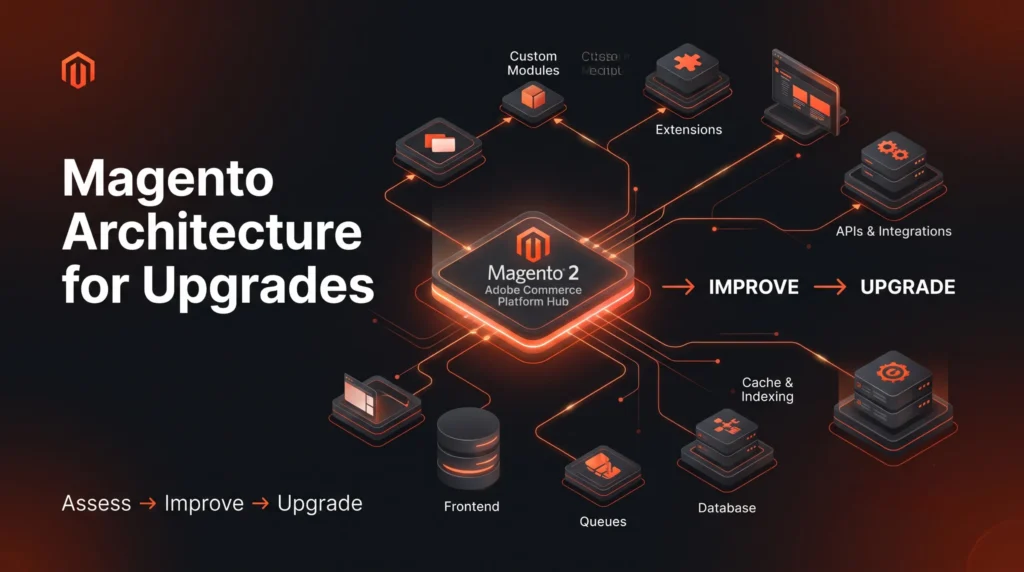
Magento and Adobe Commerce upgrades can become more complicated when a platform contains extensive customizations, third-party extensions, tightly coupled modules, or direct core modifications. We review these dependencies before an upgrade to identify areas that analyze your modules, customizations, dependencies, APIs, integrations, database usage, frontend, caching, indexing, queues, and infrastructure to create a clear view of the existing require technical attention.
Our architecture assessment can examine custom modules, extension dependencies, API integrations, customizations, and implementation patterns that may affect upgrade preparation. We then provide recommendations for improving the architecture before or during the upgrade process.
A clear separation between modules and the use of appropriate service contracts can help create more maintainable boundaries between components.
Our Magento Architecture Consulting Process
- Discovery & Requirements
We begin by understanding your ecommerce business model, Magento implementation, technical environment, integrations, current challenges, and future plans. This establishes the requirements and constraints for the architecture.
- Current Architecture Assessment
We analyze your modules, customizations, dependencies, APIs, integrations, database usage, frontend, caching, indexing, queues, and infrastructure to create a clear view of the existing architecture.
- Target Architecture Design
Based on the assessment, we define the target architecture and establish how Magento modules, service contracts, APIs, integrations, frontend components, and infrastructure should interact.
- Implementation Roadmap
We convert the target architecture into a practical implementation roadmap. This identifies technical priorities, dependencies, and suitable phases for implementing the recommended changes.
Magento Architecture Consulting Deliverables
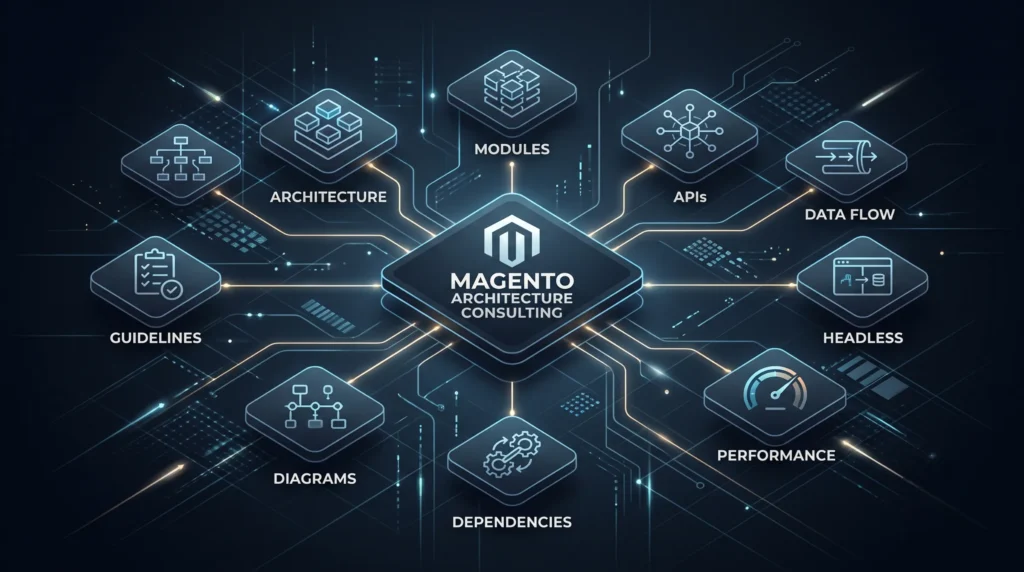
Our consulting engagement provides technical documentation and recommendations that development, architecture, and DevOps teams can use during implementation.
Typical deliverables include:
- Current-state architecture assessment
- Target Magento architecture
- Custom module architecture
- API and integration architecture
- Data-flow planning
- Headless architecture recommendations
- Performance and scalability recommendations
- Technical dependency analysis
- Architecture diagrams
- Modernization roadmap
- Implementation guidelines
Create a Magento Architecture Ready for Growth
A strong Magento architecture makes it easier to introduce new functionality, integrate external business systems, improve platform performance, and maintain the ecommerce application as requirements evolve. Our Magento Architecture Consulting services bring application structure, modules, APIs, integrations, frontend technology, data flows, and infrastructure together into a practical technical strategy.
We focus on modular design, controlled dependencies, clear interfaces, maintainable customizations, and appropriate integration patterns. This gives your development team a structured foundation for building and extending your Magento or Adobe Commerce platform.
Whether you are launching a new store, modernizing an existing implementation, preparing for an upgrade, or evaluating a headless architecture, our Magento Architecture Consulting service helps establish a clear, practical, and maintainable technical direction.