Mohamed Abbas | Architect Magento | Tech Blogger | Magento Trainer

Architect Magento | Tech Blogger | Magento Trainer
Mohamed Abbas
Architect Magento | Tech Blogger | Magento Trainer
Context Engineering for AI Agents
Introduction
AI applications today are becoming increasingly sophisticated, and building a reliable agent is no longer just about writing a good prompt. What truly determines an agent’s performance is whether it has the right information at the right moment. This is where Context Engineering comes in. It focuses on controlling and shaping the information inside an AI agent’s context window so the agent can reason properly and complete tasks effectively. While prompt engineering sets initial rules, context engineering ensures the agent stays intelligent throughout the entire task or conversation.
In this lesson-style breakdown, we explore what context engineering is, why it plays a crucial role in AI agent design, and how it differs from traditional prompt engineering. You’ll also learn how to structure, compress, and manage information so agents avoid common failures like confusion or hallucinations.
Learning Goals
By the end of this topic, you’ll understand how to:
- Explain what context engineering is and how it differs from prompt engineering
- Identify the major components that form an AI agent’s context
- Apply strategies to write, organize, condense, and manage context effectively
- Detect common context issues—such as poisoning, clash, distraction, and confusion—and learn how to fix them
What Is Context Engineering?
For an AI agent, context is the driving force behind decision-making. It shapes how the agent interprets a task and determines which actions to take next. Because LLMs have limited context windows, we must design systems that can add, remove, and compress information dynamically. Context engineering is the intentional process of managing that flow of information so the agent always sees what matters most.
Prompt Engineering vs. Context Engineering
Prompt engineering gives an agent one-time rules and instructions—static guidance.
Context engineering, however, manages continuous information. It handles everything that changes over time: user inputs, tool outputs, memory, retrieved knowledge, and conversation data.
Prompt engineering = one strong message.

Context engineering = a system that keeps the agent informed at every step.
Types of Context
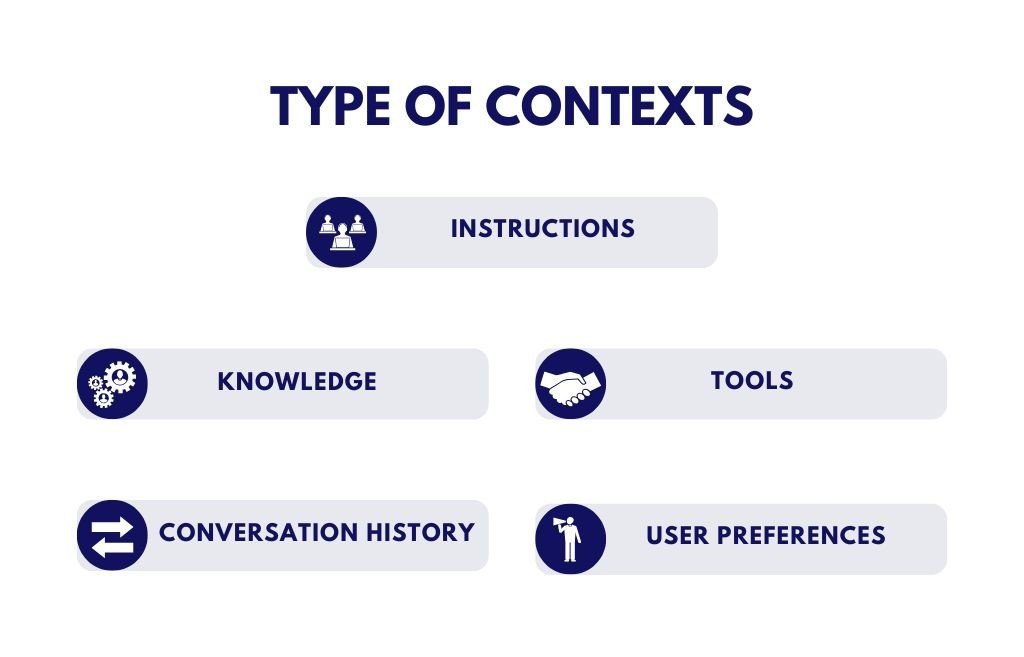
Context isn’t a single thing. It comes from several sources, and managing each type is part of building a reliable agent.
- Instructions – Prompts, system messages, rules, examples, tool descriptions
- Knowledge – Database information, documents, stored facts, RAG-retrieved data
- Tools – Function definitions, API schemas, server tools, plus their responses
- Conversation History – The ongoing user dialogue, which grows over time
- User Preferences – Saved likes, dislikes, past choices, and behavioral patterns
An agent only performs well when all these elements are correctly managed.
Strategies for Effective Context Engineering
Planning Strategies
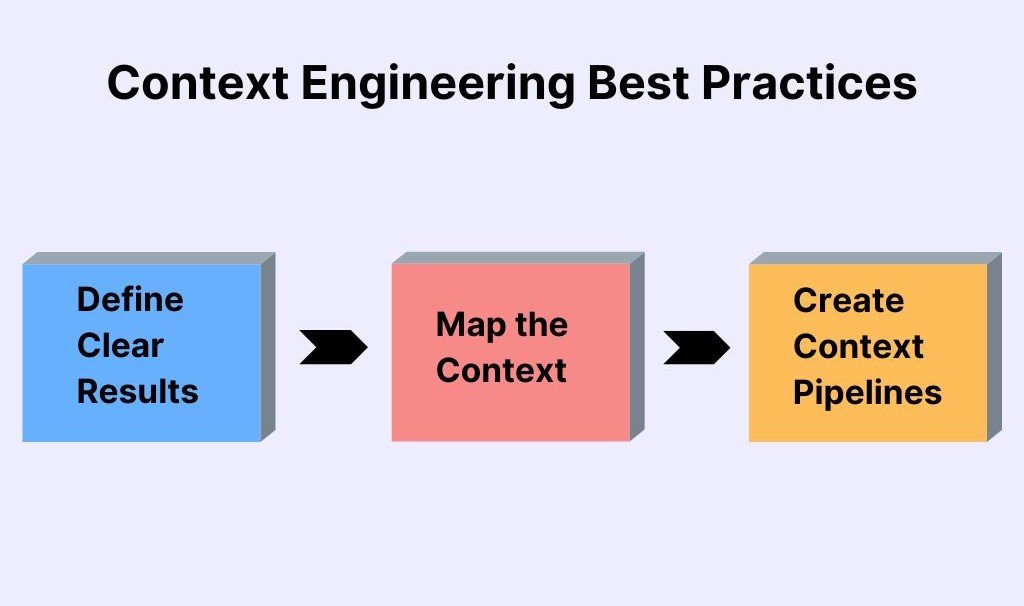
Good context engineering begins before you even build the agent.
Define Clear Results
Ask: What should the final outcome look like when the agent finishes the task?
This helps you design context around the expected result.
Map the Context
Identify what information the agent needs and where that information comes from.
Create Context Pipelines
Decide how the agent will fetch or receive this information.
This could include MCP servers, APIs, retrieval systems, or tool calls.
Practical Context Management
Once the agent starts working, the context window begins filling up. These strategies help keep it clean and useful:
Agent Scratchpad
Temporary workspace where the agent stores notes for the current session, without filling the context window.
Memories
Long-term storage for important details, summaries, and user preferences across sessions.
Compressing Context
Summarizing or trimming older messages to keep only the most relevant content.
Multi-Agent Systems
Splitting tasks across multiple agents, each with its own context window.
Sandbox Environments
Running heavy code or processing large documents outside the context window, then only passing back the essential results.
Runtime State Objects
Storing step-by-step data for a complex workflow, so only the relevant subtask information is kept in context.
Example of Context Engineering
Imagine the user says: “Book me a trip to Paris.”
A basic prompt-only agent would simply respond:
“Sure, when would you like to travel?”
But an agent using context engineering would think further. Before replying, it may:
- Check your calendar to see when you’re free
- Recall your past travel habits and preferred airlines
- Consider your typical budget range
- Identify which booking tools are available
Then it might say:
“You’re free during the first week of October. Should I find direct flights on your preferred airline within your usual budget?”
This is the difference: context-aware agents act with intelligence instead of just reacting.
Common Context Failures
- Context Poisoning
When hallucinated or false information enters the context and gets repeatedly reused, causing the agent to pursue impossible tasks.
Fix: Validate information before saving it to memory. Quarantine suspicious data.
- Context Distraction
The agent gets overwhelmed by too much history or irrelevant information and starts giving unfocused or repetitive responses.
Fix: Summaries and regular context compression.
- Context Confusion
Too many tools or too much tool information causes the model to misuse tools or call incorrect APIs.
Fix: Use RAG to select only the most relevant tools for each request.
- Context Clash
Contradicting information remains in the context, causing inconsistent decisions.
Fix: Prune or override outdated details. Keep only the final instruction.
Conclusion
Context engineering is essential for building AI agents that can handle complex, real-world tasks reliably. While prompt engineering sets the foundation, it’s context engineering that keeps the agent intelligent throughout the entire journey. By managing information with care—through summaries, retrieval systems, memories, and structured pipelines—developers can create agents that act accurately, consistently, and intelligently over long interactions. As AI grows more capable, mastering context engineering becomes a critical skill for professional, production-ready AI solutions.