Magento Headless Development Services
Transform your Magento store with our headless development services designed to deliver faster, more flexible, and highly engaging ecommerce experiences. We build scalable headless architectures that seamlessly connect Magento’s powerful commerce capabilities with modern frontend technologies, enabling improved performance, personalized experiences, and seamless omnichannel interactions. From custom storefronts and API integrations to third-party system connectivity, our solutions are tailored to meet your unique business requirements. Empower your ecommerce brand with a future-ready Magento headless solution built for flexibility, scalability, and growth.
Magento Headless Development Services
Build a flexible, API-driven Magento storefront by separating the frontend experience from your Magento or Adobe Commerce backend. Our Magento headless development services help you create custom storefronts using modern frontend technologies while Magento continues to manage products, customers, carts, checkout, orders, and core commerce operations.
We develop headless Magento solutions using frontend technologies such as React and Progressive Web Applications (PWA), connected to Magento through GraphQL and REST APIs. This approach gives your frontend greater flexibility while keeping Magento responsible for core commerce functionality. The frontend and backend can be developed separately, allowing customer-facing experiences to evolve without modifying the Magento theme layer.
Whether you are migrating an existing Magento store or building a new headless storefront, we handle architecture, API integration, frontend development, third-party integrations, testing, SEO, performance optimization, and deployment. Our implementation is planned around your Magento or Adobe Commerce version, extensions, integrations, catalog structure, checkout requirements, and business workflows.
What Is Magento Headless Development?
Magento headless development separates the customer-facing storefront from the Magento or Adobe Commerce backend. Instead of using Magento’s traditional theme system to render the website, a separate frontend application communicates with Magento through APIs such as GraphQL and REST.
Magento continues to manage core commerce functionality while the frontend handles the customer-facing experience. This allows businesses to create custom web storefronts, PWA experiences, and other digital touchpoints without tightly coupling the user interface to Magento’s presentation layer.
Headless architecture does not mean Magento has to be replaced with microservices. Magento can remain the central commerce platform while additional services such as search, PIM, ERP, payment, shipping, or other systems are integrated where required.
Our Magento Headless Development Services
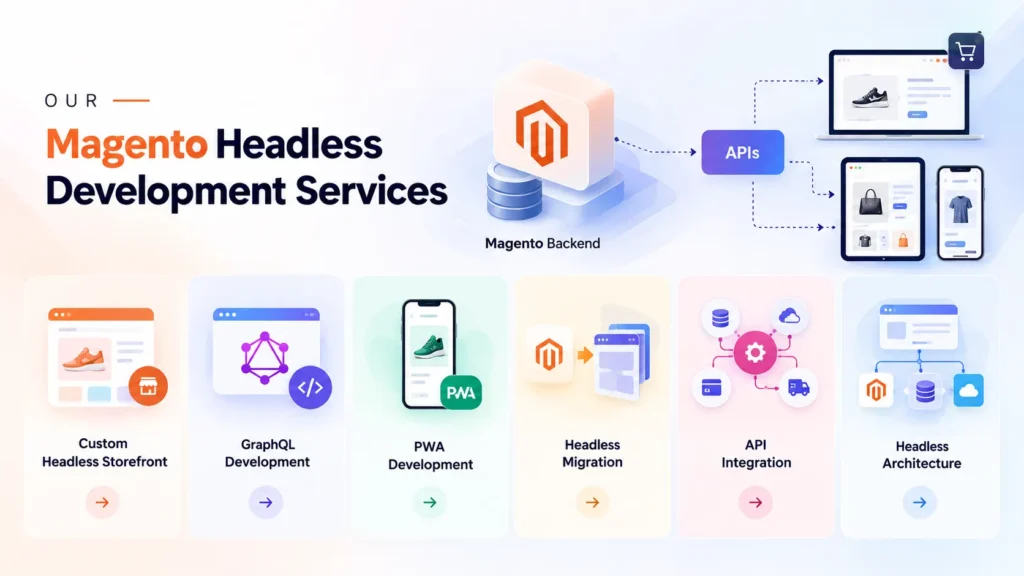
Custom Magento Headless Storefront
We develop custom storefronts that communicate with Magento through APIs instead of relying on the traditional Magento theme architecture. The frontend is designed around your product catalog, customer journeys, checkout requirements, content, and business-specific functionality.
Magento GraphQL Development
We implement GraphQL queries and mutations for product data, catalog browsing, customer accounts, carts, checkout, and other supported storefront operations. Where standard Magento APIs do not provide the required functionality, we can develop custom API or GraphQL extensions.
Magento PWA Development
We build Magento-powered Progressive Web Application storefronts for businesses that need a modern, responsive, application-like shopping experience. The PWA communicates with Magento APIs while providing a flexible frontend across desktop and mobile devices.
Headless Magento Migration
We migrate traditional Magento storefronts to a decoupled frontend while keeping Magento as the commerce backend. Before migration, we review existing extensions, customizations, integrations, checkout functionality, URLs, SEO, analytics, and API requirements.
Magento API Integration
We connect headless Magento storefronts with ERP, PIM, CRM, search, payment, shipping, tax, inventory, and other external systems. Each integration is planned around authentication, data ownership, API contracts, error handling, caching, and synchronization requirements.
Magento Headless Architecture
A typical headless Magento implementation separates the presentation layer from the commerce backend while allowing external services to be integrated where necessary. The frontend communicates with Magento through its APIs, while Magento continues to provide the underlying commerce functionality.
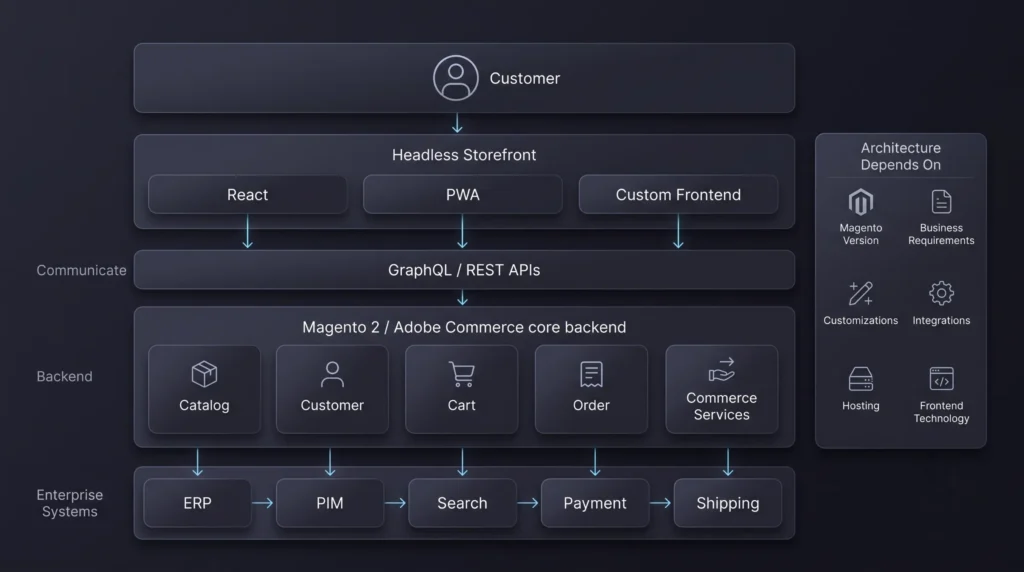
The exact architecture depends on your Magento version, business requirements, existing customizations, integrations, hosting environment, and frontend technology. We design the API and frontend layers around these requirements rather than applying the same architecture to every project.
Magento Headless Features
Our headless Magento development can cover the complete customer shopping journey, from product discovery through checkout and account management. The functionality is implemented according to the capabilities of your Magento or Adobe Commerce environment.
- Custom product and category pages
- Magento GraphQL and REST integration
- Product search and filtering
- Customer registration and login
- Cart and checkout functionality
- Product and inventory integration
- Payment and shipping integration
- PWA storefront development
- ERP, PIM, and CRM integrations
- SEO-friendly URLs and metadata
- Analytics and conversion tracking
- API and frontend performance optimization
Magento Headless for B2C and B2B
For B2C businesses, we build custom storefronts focused on product discovery, search, navigation, customer accounts, cart management, and checkout. The frontend can be designed independently from Magento while continuing to use Magento’s catalog and commerce capabilities.
For B2B businesses, we consider requirements such as company accounts, customer roles, shared catalogs, pricing, purchasing workflows, and other Adobe Commerce B2B functionality. These requirements are mapped against the available Magento APIs before frontend development begins.
Our Magento Headless Development Process
We begin by reviewing your Magento or Adobe Commerce environment, including its version, modules, customizations, integrations, catalog, checkout, and business requirements. This helps us identify existing API capabilities and determine where custom API development may be required.
We then define the frontend architecture, API communication, authentication, caching, routing, rendering strategy, and external integrations. Once the architecture is established, we develop the storefront and connect it with Magento’s GraphQL or REST services.
After development, we test catalog functionality, customer accounts, cart, checkout, integrations, responsive behavior, SEO, analytics, and API responses. We then handle deployment, monitoring, caching, and post-launch optimization.
Development Stages
- 1. Magento & requirements analysis
- 2. Frontend and API architecture
- 3. Headless storefront development
- 4. GraphQL / REST integration
- 5. Third-party integrations
- 6. Testing and performance optimization
- 7. Deployment and ongoing support
Magento Headless vs Traditional Magento
The main difference is where the customer-facing frontend is built. A traditional Magento storefront uses Magento’s theme architecture, while a headless implementation uses a separate frontend application that communicates with Magento through APIs.
| Area | Traditional Magento | Headless Magento |
|---|---|---|
|
Frontend |
Magento theme |
Separate frontend |
|
Backend |
Magento |
Magento / Adobe Commerce |
|
API usage |
Limited for frontend |
Core to architecture |
|
Frontend technology |
Performance |
Application, database, cache, and API factors |
|
Deployment |
Closely connected |
Can be independent |
|
Custom UI |
Theme-based |
Application-based |
Headless development provides greater frontend flexibility, but it also introduces additional responsibilities around API development, frontend architecture, caching, testing, deployment, and extension compatibility. These factors should be evaluated before moving an existing Magento store to a headless architecture.
Magento Headless Performance & SEO
A headless architecture does not automatically make a Magento website faster. Performance depends on frontend rendering, API response times, caching, JavaScript execution, images, Magento configuration, hosting, and third-party services. These areas need to be considered together when designing and optimizing the storefront.
We optimize API requests, frontend assets, images, caching, rendering, and application behavior to improve the overall storefront experience. For SEO, we implement appropriate URLs, metadata, canonical tags, structured data, redirects, internal linking, and suitable rendering strategies for indexable pages.
Why Choose Magento Headless Development?
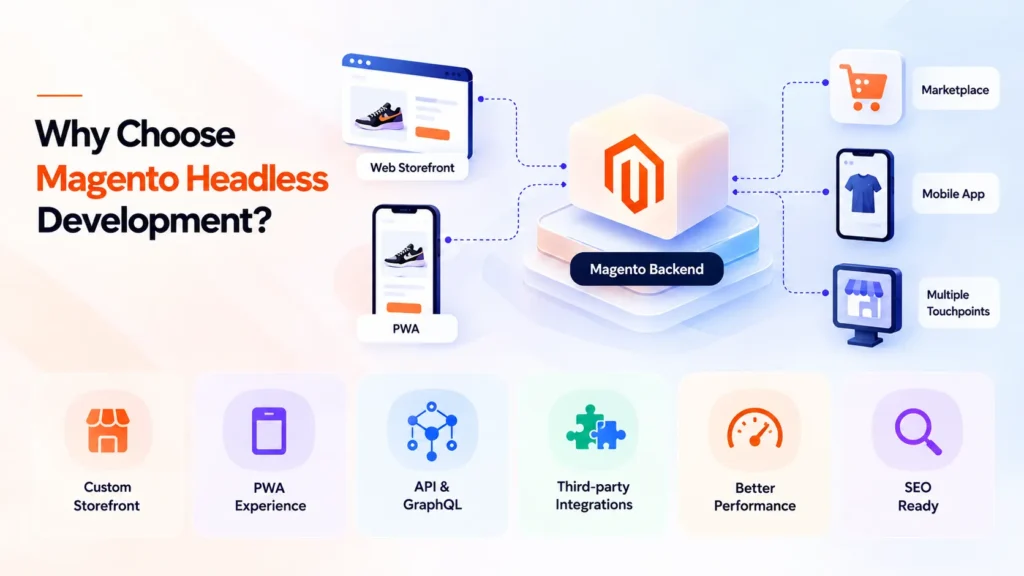
Magento headless development gives businesses greater control over the customer-facing experience while retaining Magento’s established commerce functionality. It can support custom storefronts, PWA experiences, multiple digital touchpoints, and integrations with external commerce services.
Our approach covers both frontend and backend requirements, including Magento APIs, GraphQL, custom development, third-party integrations, SEO, performance, testing, and deployment. This helps create a maintainable storefront that can evolve independently from the Magento presentation layer.
Start Your Magento Headless Development Project
Transform your Magento storefront with a flexible, API-driven headless architecture built around your business requirements. We can help with Magento headless architecture, React and PWA storefronts, GraphQL and REST integration, custom APIs, third-party integrations, migration, SEO, performance optimization, testing, and deployment.