Magento Custom Extension Development Services
Empower your Magento store with custom extensions designed to meet your unique business needs. Our Magento custom extension development services help you add advanced functionality, automate workflows, integrate third-party tools, and enhance the overall shopping experience. We build secure, scalable, high-performance extensions that seamlessly integrate with your existing Magento environment while ensuring flexibility, reliability, and long-term maintainability as your business grows.
Magento Custom Extension Development Services
When your Magento store requires functionality that is not available through Magento Open Source, Adobe Commerce, or an appropriate third-party extension, custom extension development provides a structured way to add that functionality. We develop Magento 2 extensions around your business requirements using Magento’s supported architecture and extension points. Depending on the requirement, this can include dependency injection, service contracts, plugins, observers, APIs, database schema, UI components, cron jobs, message queues, and asynchronous processing.
A custom extension can support catalog, checkout, pricing, customer, order, Admin, API, and third-party integration requirements. We first understand your business workflow and existing Magento environment before defining the module structure and technical approach. This keeps custom functionality separated from Magento core code while allowing it to interact with the platform through appropriate extension mechanisms. For applicable Adobe Commerce projects, we can also consider out-of-process extensibility when custom logic or integrations are better suited to external applications, APIs, events, webhooks, or App Builder.
Custom Magento Extension Development for Business Requirements
Every Magento store can have different catalog structures, pricing rules, checkout processes, fulfillment workflows, and integration requirements. When standard Magento functionality cannot meet these requirements, a custom module can encapsulate the required business logic within a dedicated extension. This helps avoid distributing custom functionality across unrelated files and provides a clearer separation between Magento functionality and your business-specific logic.
Before development, we review your Magento version, installed extensions, existing customizations, integrations, and functional requirements. We determine whether the requirement can be handled through existing Magento capabilities or whether a dedicated extension is appropriate. The technical design then identifies the required services, extension points, data structures, APIs, frontend components, and background processes.
Our Magento Custom Extension Development Services
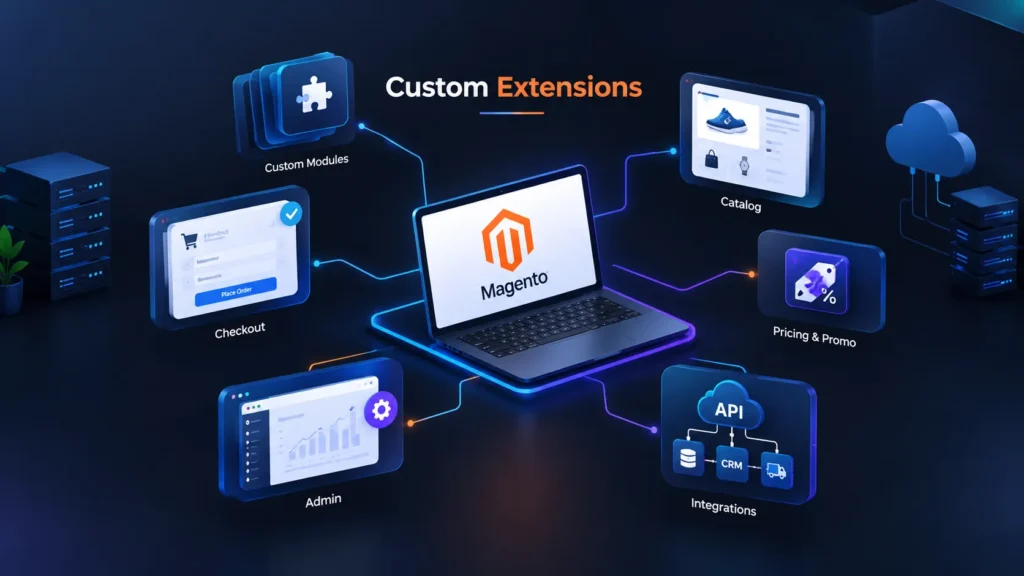
Custom Magento Module Development
We develop Magento 2 modules for custom business logic, workflows, configuration, data processing, APIs, and application functionality. Modules are structured around Magento’s modular architecture with clearly defined responsibilities and explicitly managed dependencies. This provides a cleaner foundation for testing, maintenance, and future enhancements without unnecessarily coupling the extension to unrelated modules.
Custom Checkout Extensions
We develop checkout customizations for additional fields, validation, delivery requirements, customer-specific workflows, and other business rules. Depending on the storefront architecture, implementation may involve Magento UI components, frontend JavaScript, backend services, and server-side validation. For stores using alternative frontend architectures such as Hyvä or headless implementations, the checkout approach is designed specifically for that frontend architecture.
Catalog and Product Extensions
Custom catalog extensions can support specialized product attributes, product relationships, catalog workflows, bulk operations, and custom product-processing requirements. We consider Magento’s product data model, APIs, indexing, caching, and database access patterns when designing the functionality. This helps the extension integrate with existing catalog operations without introducing unnecessary processing.
Custom Pricing and Promotion Extensions
We can implement pricing and promotional logic based on customers, quantities, products, contracts, membership conditions, or other defined business requirements. The implementation is selected according to whether the requirement affects product pricing, cart totals, discounts, or another part of the Magento pricing workflow. This keeps custom calculations within the appropriate Magento processing layer.
Magento Admin Extensions
We develop custom Magento Admin functionality such as grids, forms, configuration sections, filters, reports, mass actions, and workflow interfaces. Custom administrative functionality can use Magento UI components and access-control mechanisms to provide appropriate interfaces and permissions. This allows internal teams to manage custom business processes within the Magento Admin environment.
Magento API and Integration Extensions
We develop REST and GraphQL integrations for ERP, CRM, PIM, WMS, marketplaces, shipping platforms, and other external systems. Depending on the integration, the solution can include authentication, data mapping, validation, logging, error handling, retries, and synchronization tracking. Magento service contracts can also be used where defined service interfaces are appropriate for communication between modules and service-layer functionality.
Magento Extension Migration and Compatibility Updates
Existing custom or third-party extensions may require updates when Magento or Adobe Commerce is upgraded. We can review outdated APIs, dependencies, database changes, frontend compatibility, customizations, and module conflicts. Where appropriate, older implementations can be refactored to use supported Magento extension mechanisms rather than relying on direct core modifications.
Magento Extension Development Using Native Architecture
We develop in-process Magento extensions using supported architectural patterns and extension points such as dependency injection, service contracts, plugins, observers, and module configuration where they fit the specific requirement. Dependency injection allows classes to receive their dependencies rather than creating them directly, helping reduce unnecessary coupling. Plugins can modify the behavior of supported public methods without directly changing the original class implementation.
Database functionality is implemented using Magento’s supported database mechanisms, including declarative schema and data or schema patches where applicable. Custom modules should have clearly defined responsibilities and explicit dependencies rather than creating unnecessary relationships with other modules. This approach makes the extension easier to understand, test, maintain, and update as the application evolves.
Magento Custom Extension Development Process
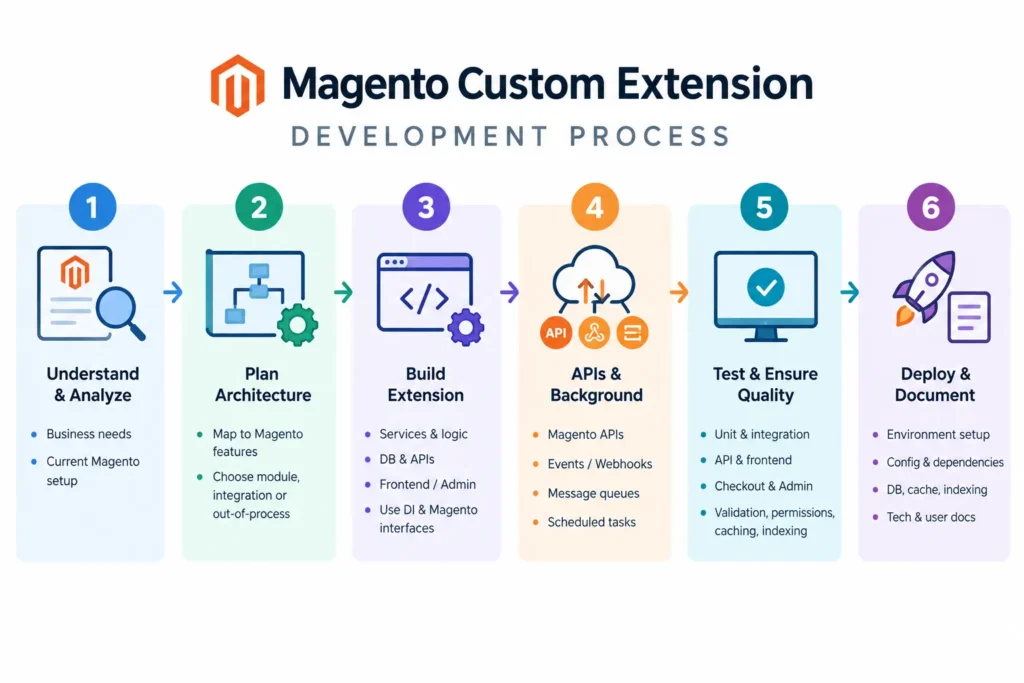
Our development process begins with understanding your business requirement and existing Magento environment. We then define the technical architecture before implementation, including dependencies, data requirements, integration points, extension mechanisms, and affected Magento workflows. This provides a clear development plan and helps identify potential conflicts before coding begins.
Requirement and Architecture Analysis
We review your Magento version, installed extensions, customizations, integrations, and business workflow. The requirement is then mapped to appropriate Magento functionality and extension points. We determine whether the solution should be implemented as an in-process module, an integration, or, for applicable Adobe Commerce environments, an out-of-process application.
Extension Development
The extension is developed with the required services, business logic, database components, APIs, frontend functionality, or Admin features. Dependency injection and appropriate Magento interfaces are used to keep components appropriately decoupled. Plugins, observers, service contracts, and other extension mechanisms are selected according to the specific functionality being implemented.
API and Background Processing
External integrations can use Magento APIs, Commerce events, webhooks, message queues, or scheduled processing depending on the integration workflow and target Commerce environment. For applicable Adobe Commerce projects, out-of-process extensibility can connect external applications with Commerce through supported APIs, events, webhooks, and related extensibility services.
Testing and Quality Assurance
We test the extension against its functional requirements and the Magento workflows it affects. Depending on the project, testing can include unit testing, integration testing, API testing, frontend testing, checkout scenarios, Admin workflows, and regression testing. We also verify validation, permissions, error handling, indexing, caching, and interactions with related modules.
Deployment and Documentation
The completed extension is prepared for deployment according to the target Magento environment. Configuration, dependencies, database changes, cache and indexing requirements, and deployment considerations are documented where required. Technical documentation can also cover extension configuration, APIs, scheduled processes, and integration dependencies.
Key Technical Capabilities
Our Magento custom extension development capabilities include:
- Magento 2 custom modules
- Dependency injection and service contracts
- Plugins and observers
- REST and GraphQL APIs
- Custom Admin UI components
- Custom checkout functionality
- Catalog and product customization
- Pricing and promotion logic
- Declarative database schema and patches
- ERP, CRM, PIM, WMS, and marketplace integrations
- Cron jobs and message queues
- Event-driven integrations
- Webhook-based integrations
- Custom data-processing workflows
- Unit and integration testing
- Magento extension compatibility updates
Custom Magento Extensions for Third-Party Integrations
Magento stores often need to exchange information with ERP, CRM, PIM, WMS, accounting, marketplace, or fulfillment systems. A custom extension or integration layer can handle product, customer, inventory, pricing, order, invoice, and shipment data according to the requirements of each system. The architecture can include data mapping, validation, authentication, logging, retries, and synchronization tracking.
For applicable Adobe Commerce environments, integrations can also use supported events and webhooks to communicate with external applications. Where appropriate, external applications can handle specific custom workloads outside the Commerce application process. This allows the integration architecture to be designed according to data volume, processing requirements, and the capabilities of the connected systems.
Magento Extension Performance and Scalability
Custom extensions need to account for database operations, indexing, caching, API requests, plugins, observers, and background processing. We avoid unnecessary database queries and repeated entity loading and consider asynchronous processing for workloads that do not need to execute during a customer-facing request. Performance decisions are made according to the functionality, traffic patterns, and data volume of the store.
For high-volume Magento environments, we review database access, collection usage, cache behavior, queue processing, and custom application logic as part of the extension design. The objective is to avoid introducing unnecessary processing into critical storefront and administrative workflows while keeping the module maintainable.

Security-Conscious Magento Extension Development
Custom extensions can process customer information, order data, administrative actions, and external integration data. We therefore consider authentication, authorization, input validation, output escaping, API access, administrative permissions, and configuration security during development. Custom Admin functionality can use Magento’s access-control mechanisms so permissions can be assigned according to administrator roles.
Security considerations also apply to integrations and background processes. External credentials, API endpoints, webhook communication, scheduled jobs, and custom data processing should be designed according to the security requirements of the specific environment. The implementation should complement Magento’s existing security model rather than bypassing it.
Why Build a Custom Magento Extension?

A custom extension provides a dedicated way to implement functionality that cannot be handled effectively through Magento configuration or an appropriate existing extension. Instead of modifying Magento core files or distributing business logic across different areas of the application, the functionality can be organized inside a purpose-built module. This gives the customization a defined structure for development, testing, maintenance, and future enhancements.
Custom development also allows functionality to be designed around your existing Magento environment. The extension can account for your catalog, customer model, pricing rules, checkout workflow, order process, Admin requirements, and external integrations. This allows the implementation to follow your actual business workflow rather than forcing that workflow into a generic extension.
When Should You Choose a Custom Extension?
Custom development can be considered when the required functionality is specific to your business and cannot be implemented cleanly through existing Magento capabilities. It can also be useful when several unrelated extensions would otherwise be required to support a single business process. Before development, the existing platform functionality and installed extensions should be reviewed to determine the most appropriate technical approach.
Typical requirements include:
- Custom business workflows
- Specialized checkout functionality
- Custom catalog or product functionality
- Customer-specific pricing or business rules
- Custom Magento Admin tools
- ERP, CRM, PIM, WMS, or marketplace integrations
- Custom REST or GraphQL functionality
- Existing extension compatibility updates
- Refactoring of legacy Magento customizations
- Custom functionality that should remain separate from Magento core
Magento Open Source and Adobe Commerce Extension Development
We develop custom functionality for Magento Open Source and Adobe Commerce according to the target platform version and environment. Traditional in-process extensions can use Magento PHP modules, plugins, observers, services, APIs, and other supported mechanisms. For applicable Adobe Commerce environments, custom functionality can also use out-of-process extensibility with APIs, events, webhooks, and Adobe App Builder.
The appropriate architecture depends on the specific requirement, platform edition, deployment model, integrations, and operational needs. We therefore define compatibility and implementation requirements during the technical planning stage rather than assuming that the same extension architecture applies to every Magento installation.
Magento Extension Maintenance and Enhancement

Custom extensions may require ongoing maintenance as business requirements, Magento versions, dependencies, or external APIs change. Maintenance can include bug fixes, compatibility updates, performance improvements, integration changes, security updates, and additional functionality. A structured module architecture provides a defined codebase for making these changes without unnecessarily affecting unrelated Magento functionality.
We can also review existing custom extensions that have become difficult to maintain. The review can identify outdated APIs, unnecessary class overrides, tightly coupled components, inefficient database operations, module conflicts, or other architectural issues. Depending on the findings, specific components can be refactored or redesigned using more appropriate Magento extension mechanisms.
Build a Magento Extension Around Your Business Requirements
Your Magento store may require functionality that cannot be addressed through standard configuration or generic third-party extensions. Our Magento custom extension development approach starts with your business workflow and translates the requirement into a structured technical solution. From custom checkout and catalog functionality to pricing rules, Admin tools, APIs, and third-party integrations, we develop functionality according to the Magento architecture appropriate for your environment.
Whether you are building a new extension, replacing an existing customization, integrating Magento with an external system, or updating a legacy module, we can define the architecture, develop the required functionality, test the implementation, and prepare it for deployment. The result is a purpose-built Magento solution designed around your store’s technical environment and business requirements.
Discuss your Magento custom extension requirements with our development team and plan the right technical approach for your store.