Magento Development Services
Build powerful, scalable, and high-performing Magento stores tailored to your business needs. Our expert Magento development services deliver seamless shopping experiences, custom functionality, robust performance, and flexible solutions designed to help your eCommerce business grow.
Build, customize, integrate, and maintain ecommerce applications using Magento and Adobe Commerce. Our Magento development services cover storefront customization, custom modules, API integrations, third-party integrations, upgrades, performance optimization, security maintenance, and technical support.
We use Magento’s supported extension mechanisms and established architecture instead of modifying core platform code. This keeps custom functionality more maintainable and reduces complications when the application requires future upgrades, extensions, or technical changes.
Custom Magento Development
Magento’s modular architecture allows developers to extend the platform for business-specific requirements. Custom development is useful when standard configuration or existing extensions cannot provide the required functionality, allowing the ecommerce application to support specific business rules and workflows.
Custom functionality can be implemented through Magento modules and supported extension points, including dependency injection, plugins, observers, controllers, UI components, configuration, database schema, and APIs. Custom development should avoid direct core modifications to maintain a cleaner application structure.
-
Custom Business Rules & Workflows
Tailored processes for your specific business operations
-
Product & Catalog Functionality
Custom features for managing products and catalog data.
-
Customer-Specific Functionality
Features designed around different customer requirements
-
Custom Administrative Features
Admin tools and controls for your store management needs.
-
Custom Checkout Requirements
Checkout functionality tailored to your business processes.
-
Store-Specific Ecommerce Features
Unique ecommerce features built for your store
Magento Theme & Storefront Development
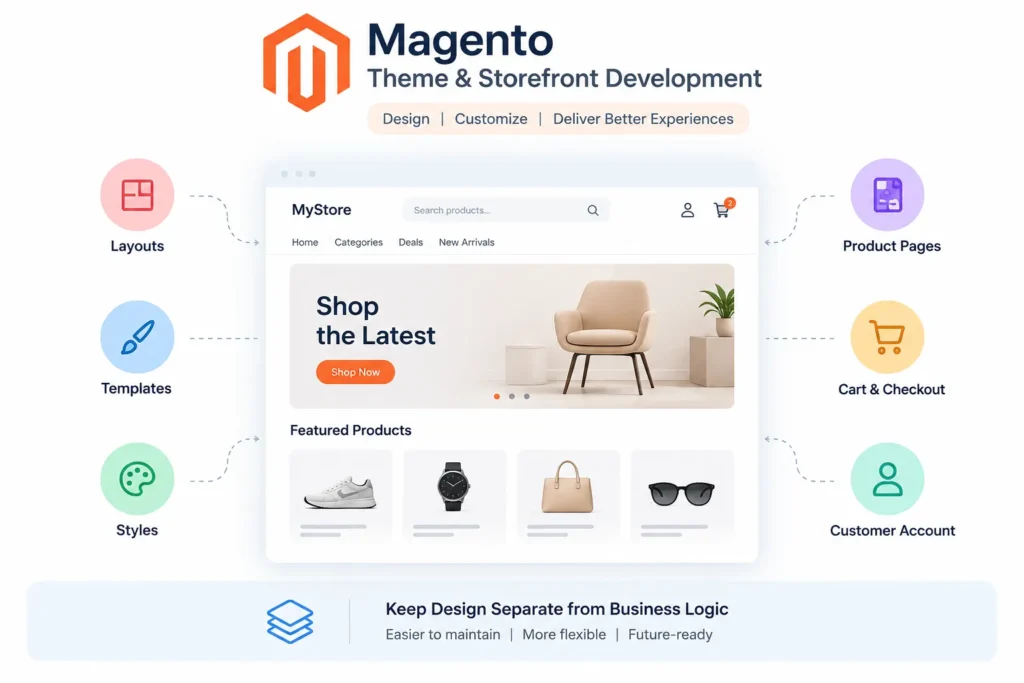
Magento storefront development focuses on the customer-facing experience of an ecommerce store. Themes, layouts, templates, styles, and JavaScript can be customized to support the required design and functionality across product pages, category pages, navigation, search, cart, checkout, and customer account areas.
Storefront customizations should maintain separation between presentation logic and business functionality. This helps frontend changes remain easier to manage without unnecessarily affecting the underlying ecommerce application and its business logic.
Magento Module & Extension Development
Magento modules provide a structured way to add or modify application functionality. Custom modules can contain business logic, configuration, services, database functionality, APIs, administrative features, and frontend components according to the requirements of the feature being developed.
Extension development should use Magento’s dependency injection system and appropriate extension points. Plugins, observers, preferences, and other mechanisms should be selected according to the behavior that needs to be extended or modified.
- Custom business functionality
- Administrative configuration
- Custom database entities
- API functionality
- Product and customer features
- Checkout and integration logic
Magento API Development & Integration
Magento provides web APIs that allow external applications to communicate with ecommerce data and functionality. API development can connect Magento with ERP, CRM, payment services, shipping systems, marketplaces, mobile applications, and other business applications.
- Product and catalog data
- Customer information
- Orders and order data
- Inventory information
- Cart and checkout operations
- External data synchronization
Third-Party Magento Integrations
Magento can integrate with external services for payments, shipping, taxation, search, inventory, customer management, marketing, analytics, and enterprise operations. Depending on the integration, APIs, extensions, webhooks, message queues, or scheduled synchronization can be used.
Integration design should define how data moves between systems, including the source of truth, synchronization requirements, authentication, error handling, and failure recovery. The implementation method depends on the technical capabilities of both Magento and the external platform
Payment Integration
Connect Magento with payment services required for ecommerce transactions.
ERP & CRM Integration
Exchange relevant ecommerce and business data with enterprise systems.
Shipping Integration
Connect Magento with shipping and carrier services.
Marketplace Integration
Exchange relevant catalog and order information with marketplaces.
Magento Migration & Upgrade Services
Magento migration and upgrade projects require an assessment of the existing application, including custom modules, themes, extensions, integrations, configuration, and data. These dependencies can affect the work required when moving to another environment or Magento version.
For upgrades, compatibility between the target Magento version, PHP version, extensions, custom code, and infrastructure must be considered. Custom code and third-party extensions may require updates when platform APIs or dependencies change.
- Application assessment
- Version compatibility analysis
- Custom module review
- Extension compatibility checks
- Data migration and validation
- Integration testing
- Post-upgrade verification
Magento Performance Optimization
Magento performance can be affected by application code, database queries, indexing, caching, frontend resources, extensions, PHP configuration, web-server configuration, and infrastructure. Performance optimization should begin by identifying the actual bottleneck before applying changes.
Performance work can involve cache configuration, indexing, database queries, custom modules, frontend resources, image delivery, external integrations, and server configuration. Magento also supports full-page caching and can be used with Varnish where appropriate, depending on the environment and requirements.
- Cache configuration
- Indexing and indexer operations
- Database queries
- Custom modules and extensions
- Frontend resources
- Server configuration
Magento Security & Maintenance
Magento security maintenance involves keeping the platform and dependencies within supported versions and applying relevant security updates. Custom code and third-party extensions should also be reviewed for compatibility when platform updates are introduced.
Ongoing maintenance can include dependency updates, extension reviews, access-control checks, configuration reviews, log analysis, and application troubleshooting. Privileged credentials should also be protected and should not be exposed through client-side JavaScript.
- Magento security updates
- Dependency updates
- Extension compatibility checks
- Custom-code compatibility
- Administrative access review
- Application and log monitoring
Magento B2B Development
B2B ecommerce implementations can require functionality that differs from typical B2C stores. Depending on the Adobe Commerce capabilities being used, requirements can include company accounts, shared catalogs, negotiated pricing, purchase orders, approval workflows, and company-specific purchasing processes.
B2B functionality should be designed around the organization’s purchasing workflow. Where available platform functionality does not meet a requirement, additional customization or integration may be necessary. Specific B2B capabilities depend on the Magento or Adobe Commerce edition and version.
- Company account management
- Shared catalogs
- Company-specific pricing
- Purchase order workflows
- Approval processes
- Business customer management
Magento Headless Commerce Development
Magento can operate as the commerce backend while a separate frontend application provides the customer-facing experience. In a headless architecture, the frontend communicates with Magento through APIs instead of depending entirely on Magento’s traditional storefront layer.
A headless implementation requires planning for product data, customer functionality, cart operations, checkout, authentication, and other commerce workflows. Magento REST or GraphQL APIs can be used according to the requirements of the frontend and backend architecture.
- Separate frontend application
- REST or GraphQL APIs
- Product and catalog data
- Cart and checkout operations
- Customer functionality
- Authentication and authorization
Magento Custom Checkout Development
Magento checkout connects cart management, customer information, shipping, payment, inventory, and order placement. Businesses may require checkout behavior or validation that differs from the standard implementation and may therefore need custom frontend or backend functionality.
Checkout customization can include additional fields, validation rules, shipping logic, payment integrations, customer-specific logic, and UI changes. These customizations should be implemented carefully because they can affect payment processing, order creation, customer data, and related ecommerce workflows.
- Additional checkout fields
- Custom validation
- Shipping customization
- Payment integration
- Customer-specific checkout logic
- Custom checkout UI
Magento Support & Troubleshooting
Magento applications can experience issues involving custom modules, extensions, checkout, payments, APIs, indexing, caching, databases, deployment, or infrastructure. Troubleshooting begins by reproducing the issue and identifying the component responsible for the problem
Application logs, server logs, exception information, configuration, recent code changes, and integration responses can be reviewed to determine the underlying cause. After implementing a fix, the affected functionality should be tested to verify the solution and check for regressions.
- Application errors
- Checkout and payment issues
- API and integration failures
- Extension conflicts
- Cache and indexing issues
- Database and deployment issues
Why Magento Development
Magento’s modular architecture allows ecommerce functionality to be extended without directly modifying the platform’s core code. Custom modules, storefront changes, integrations, and business functionality can therefore be developed around specific ecommerce requirements while remaining separated from core platform implementation.
Magento can also communicate with external systems through APIs and other integration mechanisms. This allows different systems to handle products, customers, inventory, payments, shipping, and other business operations while Magento remains part of the wider ecommerce architecture.
-
Flexible Customization
Extend Magento through modules, themes, APIs, integrations, and business logic.
-
Integration Support
Connect Magento with external applications according to required data flows and integration requirements.
-
Maintainable Development
Use supported architecture and extension mechanisms to keep custom functionality separate from core platform code.
Our Magento Development Process
01. Requirement Analysis
We identify the required business functionality and understand the existing technical environment. For an existing Magento application, this can include reviewing custom modules, themes, extensions, integrations, configuration, and current technical issues before defining the implementation approach.
02. Technical Planning
The requirements are translated into a technical implementation approach. Depending on the requirement, the solution may use Magento configuration, custom modules, theme customization, API integration, third-party integration, or a combination of these approaches.
03. Development
The planned functionality is implemented using Magento’s supported architecture and extension mechanisms. Custom code is developed separately from Magento core code and structured around the requirements of the existing ecommerce application.
04. Testing
The implementation is tested against relevant business and technical scenarios. Depending on the project, testing can include functional testing, API testing, integration testing, checkout testing, data validation, compatibility testing, and performance testing.
05. Staging & Deployment
Changes are validated in a staging environment before production deployment. Magento deployment activities can include configuration changes, database updates, dependency installation, static content deployment, cache management, and indexer operations where required.
06. Support & Maintenance
After deployment, ongoing maintenance can include security updates, compatibility fixes, troubleshooting, performance optimization, extension maintenance, monitoring, and additional development based on changing business requirements.
Magento Development for Ecommerce Applications
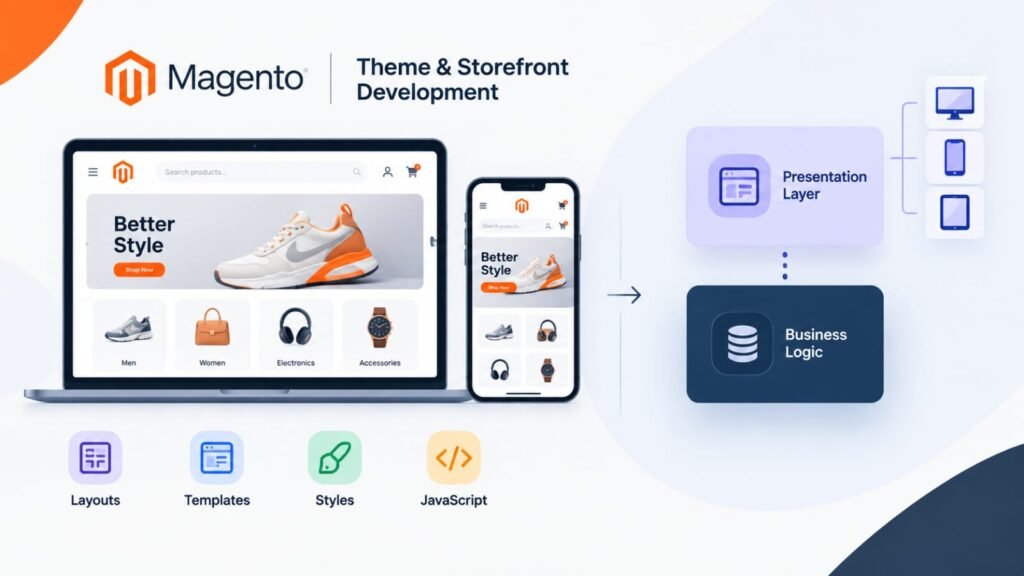
Magento development can cover individual customizations as well as complex ecommerce implementations involving multiple systems and business workflows. The appropriate technical approach depends on the store’s requirements, Magento or Adobe Commerce edition and version, existing architecture, integrations, and operational needs.
From custom modules and storefront development to API integrations, migrations, performance optimization, and ongoing maintenance, Magento development should use appropriate platform mechanisms with future maintenance in mind. A structured implementation helps keep custom functionality organized while supporting continued ecommerce development.